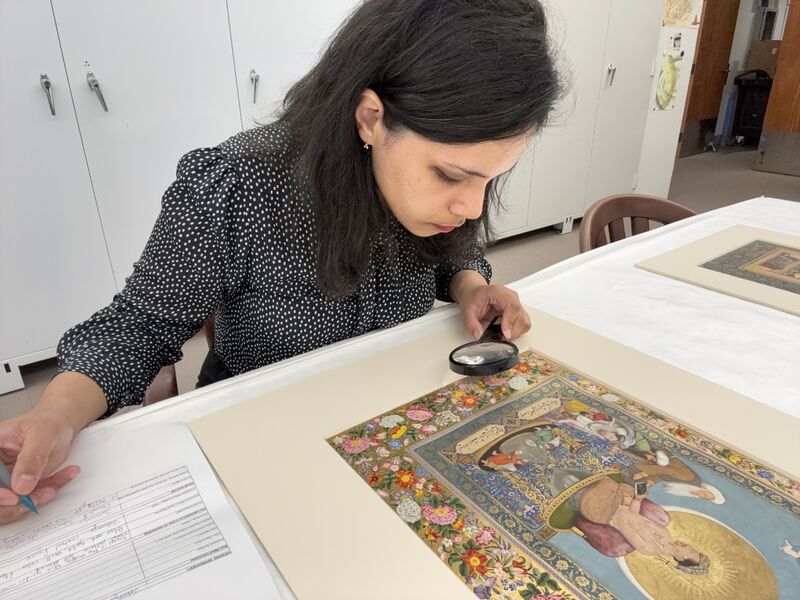
Archive Visit: National Museum of Asian Art, Washington D.C.

A few weeks ago, I had the rare opportunity to study two remarkable Mughal paintings from the collection of the Smithsonian National Museum of Asian Art in Washington, D.C. Depicting the Mughal emperor Jahangir and Empress Nur Jahan, these works are typically kept in the museum’s storage and are only brought out for major exhibitions.
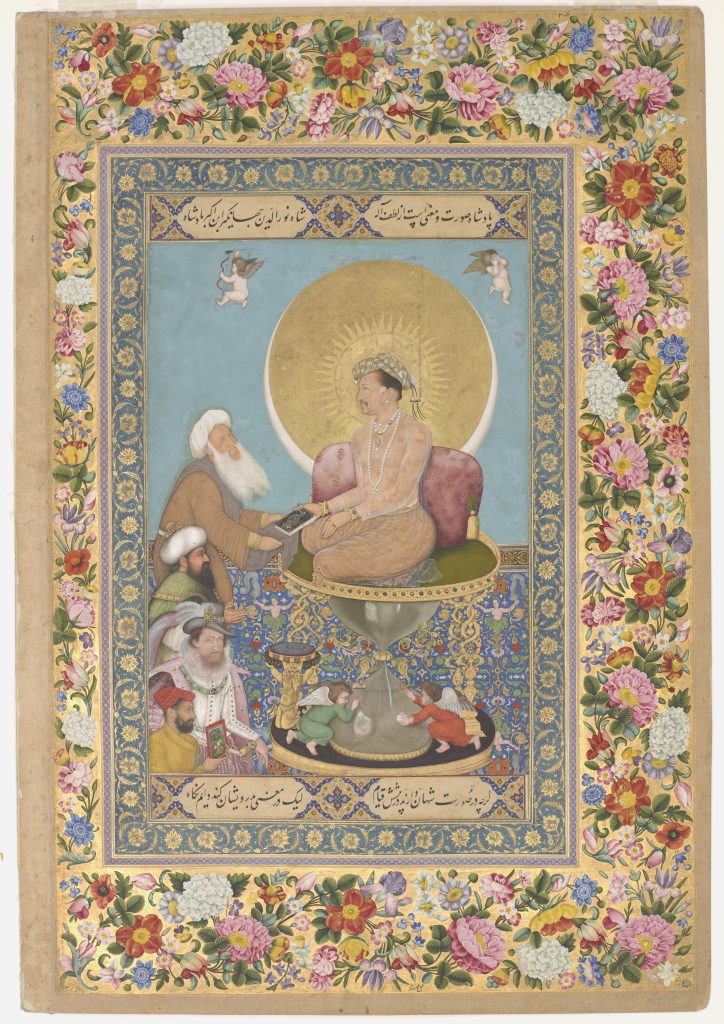
The first piece was the well-known painting by the court painter, Bichitr, which shows Jahangir showing preference for a Sufi saint over some of the world’s greatest rulers such as an Ottoman ruler and King James I of England. The Persian inscription from the painting encapsulates the Mughal emperor’s dual sovereignty, both as a spiritual and temporal leader. The inscription says: “By God’s grace Shah Nuruddin, son of Akbar Padshah, is monarch of both external form (surat) and inner meaning (ma’na). Although outwardly kings stand before him, inwardly he always keeps his gaze upon the dervishes [i.e. the Sufis].” These couplets assert Jahangir’s divinely sanctioned rule, linking him to God’s grace. It also suggests that while Jahangir interacts with political leaders, his spiritual focus remains on mystics, implying a connection to divine wisdom and spiritual enlightenment.
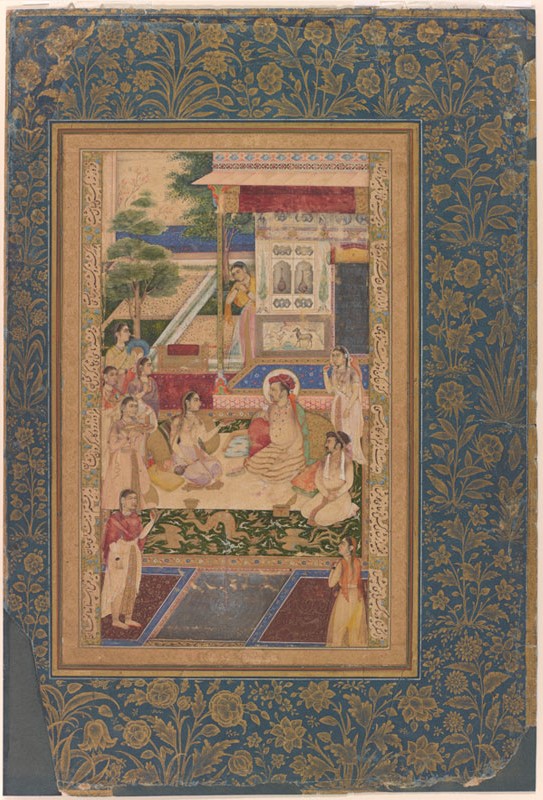
The second painting shows Nur Jahan hosting festivities for Jahangir and Shah Jahan (then known as Prince Khurram), in honor of the latter’s conquests in the Deccan. According to Ellison Banks Findly, “The party took place in October 1617 in Mandu (Sir Thomas Roe had followed the court there and was living nearby) and was accompanied by gifts of fine clothes, daggers and saddles, all studded with jewels, to Khurram and his family. While the painting reflects the continuing natural and material bounty native to the court, the porcelains in the pavilion niches are imported and stand under a gallery of paintings. Visible here are two Madonna images and four of apparently European nobility, a conjunction not inconsistent with the still-varied European presence at court. As important as the venue, however, are the personnel: although Jahangir is still the dominant figure (the nimbus was just then becoming an important iconographic element), he now shares the viewer’s attention with Nur Jahan, who is not only clearly in charge but supported as well by an army of women. While they do not intimidate, their numbers and their confident demeanor celebrate an autonomous environment of pleasure in which Jahangir and Khurram are still, and decidedly guests.” [Ellison Banks Findly, “The Pleasure of Women: Nur Jahan and Mughal Painting.” Asian Art Journal, Spring 1993].
These paintings are an important primary source for my dissertation research. After spending countless hours examining digital images of them over the years, seeing them in person was an entirely different experience.
I am deeply grateful to Christina Popenfus for generously granting me access to the museum’s study collection and for allowing me the time to examine these extraordinary works so carefully.
The visit was memorable for another reason as well: it was my daughter’s first time inside a museum. Sharing that moment while engaging with artworks that have shaped my own scholarly journey made it especially meaningful.